Series 10/13 · Book preview → Series hub
Open any case file and a network is already there. “Her insomnia feeds the worry, the worry feeds the fatigue, the fatigue makes her withdraw, and withdrawing makes the worry louder.” That sentence is a set of nodes and edges. Clinicians have drawn these diagrams in prose for a century — on intake forms, in supervision, on the back of a chart. The question here is narrow and practical: what happens when you draw the wiring explicitly, and what doesn’t change when you do.
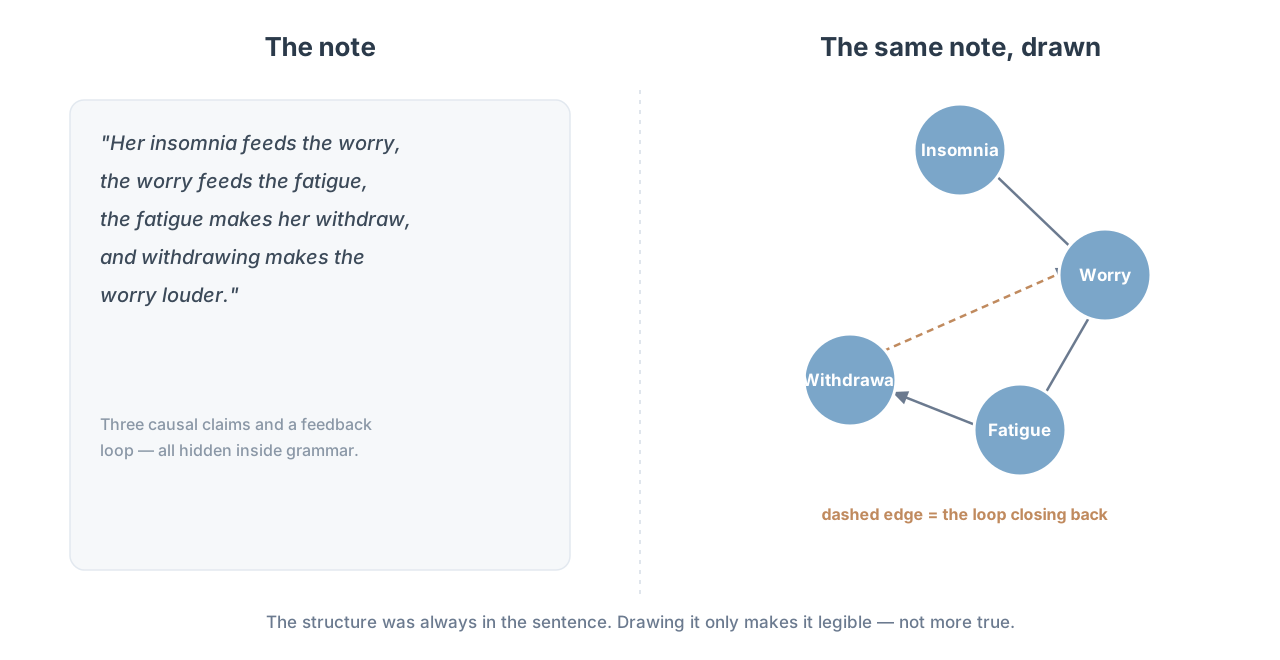
Formulation is already a network — just an implicit one
Case formulation is the working hypothesis a clinician builds about how one person’s difficulties hang together. Every major tradition has a version of it: the CBT cross-sectional formulation, the psychodynamic formulation, the “5 Ps” — predisposing, precipitating, perpetuating, protective, presenting. What they share is structure: this leads to that, which loops back to the first thing. That is a graph. The nodes are complaints, behaviours, situations, beliefs; the edges are the connections the clinician infers between them.
Keeping that graph in prose has a cost. Prose hides the structure inside grammar. One sentence can smuggle in three causal claims and a feedback loop without marking any of them, and two clinicians reading the same note can walk away with two different diagrams in their heads. Writing the nodes and edges down doesn’t make the formulation more true — it makes it more legible: to the clinician, to a supervisor, and to whoever reads the note six months later.
What the explicit version adds
Three things become available once the wiring is on the page rather than in the sentence.
You can see the loops. Feedback is the heart of most formulations and the first casualty of prose. Drawn as edges, a reinforcing loop — withdrawal → more rumination → lower mood → more withdrawal — stops being a phrase you nod at and becomes a shape you can point to and question. Is that edge really there? In this person, or only in people like them?
You can see the disagreements. When a supervisor and a trainee draw the same case and the diagrams differ, the difference is now a specific edge, not a vague sense that the two are “seeing it differently.” The conversation sharpens because what they disagree about is concrete.
You can track change over time. A formulation isn’t fixed. Keep the explicit version and redraw it across sessions, and you have a record of how your picture of the person shifted — a record of your own clinical reasoning, not a measurement of the person’s brain.
Three things the explicit version does not add
This is where the method earns trust — by refusing to overreach.
It is not a diagnosis. A node-edge map describes how one clinician thinks a person’s complaints relate. It does not assign a category, confirm one, or rule one out. Drawing the network and naming the disorder are different acts, and the first does not do the second.
A central node is not an intervention target. This is the single most seductive error in the whole area, so it is worth stating flatly. Centrality — one node connecting to many others in the drawing — describes a position in a structure. On its own, it does not tell you that pushing on that node will move the rest. The research is explicit about this: what centrality measures, and whether it identifies good treatment targets, are two separate questions — and the second has not been answered yes (Bringmann et al., 2019; Robinaugh et al., 2016). A “central” symptom is a hypothesis worth raising in supervision, not an instruction.
An average network is not this person. Most published symptom networks are estimated across many people; they describe the between-person structure. A formulation is about the one person in the room. The two can look alike and still disagree, because what holds on average need not hold for any individual (Molenaar, 2004; Fisher et al., 2018). When a clinician borrows the shape of a group-level reference network to think about an individual, that reference is a prompt for hypotheses — not a readout of the person’s own causal machinery.
Where a tool fits — and where it stops
If making the wiring explicit is useful, software can take the mechanical part: laying out the nodes, keeping the loops visible, holding successive versions side by side so change is easy to see. That is roughly what PsyNexa’s case-note workspace is built toward — a place to render a formulation as a structure and watch your own picture evolve across sessions.
The division of labour is worth stating precisely, because it is the whole point. The tool can draw the structure, surface candidate connections, and raise questions — is there an edge here? did this loop tighten since last month? What it cannot do, and should not pretend to do, is author the formulation. The hypotheses, the edits, the call on which connections are real in this person and which are artefacts of the reference data — those are the clinician’s. Whatever such a tool produces is raw material: exploratory questions and tentative links that a reviewer accepts, rewrites, or discards. The formulation that ends up in the file is authored by the person who signed it, not by the software that helped lay it out.
That is the honest version of “clinical notes as a network.” Not a machine that formulates for you — a way of drawing what you were already formulating, so that you, and the people you reason with, can see it, argue with it, and watch it change.
References
- Bringmann, L. F., Elmer, T., Epskamp, S., Krause, R. W., Schoch, D., Wichers, M., Snippe, E., & Wigman, J. T. W. (2019). What do centrality measures measure in psychological networks? Journal of Abnormal Psychology, 128(8), 892–903.
- Fisher, A. J., Medaglia, J. D., & Jeronimus, B. F. (2018). Lack of group-to-individual generalizability is a threat to human subjects research. Proceedings of the National Academy of Sciences, 115(27), E6106–E6115.
- Molenaar, P. C. M. (2004). A manifesto on psychology as idiographic science: Bringing the person back into scientific psychology, this time forever. Measurement: Interdisciplinary Research and Perspectives, 2(4), 201–218.
- Robinaugh, D. J., Millner, A. J., & McNally, R. J. (2016). Identifying highly influential nodes in the complicated grief network. Journal of Abnormal Psychology, 125(6), 747–757.
The tenth post in a 13-part series on network psychometrics.