Series 13/13 → Series hub
For twelve weeks this series has been about ideas: why depression and anxiety travel together, what centrality can and cannot tell you, why EBICglasso works with partial correlations, how far a network can be trusted, where the network view came from, and how it meets case formulation.
This last post is about the platform I have been building alongside those ideas. PsyNexa is a network psychometrics platform that sets a person’s own scores beside reference symptom networks estimated from public data. It opens on 1 February 2027 with a free beta period, in the countries where our legal review is complete.
I want to describe it the way the series has described everything else: what it shows, what it is built on, and — just as carefully — what it does not do.
What you see
Each questionnaire in PsyNexa has the same page. On the left is a three-dimensional symptom network; on the right, tabs for an overview, centrality, pathways through the network, an interpretation guide, and score entry.
The network on that page is a reference network: a regularised partial correlation network (EBICglasso; Epskamp & Fried, 2018) estimated from a large public dataset, with its source named on the page. The PHQ-9 network is estimated from the US National Health and Nutrition Examination Survey (NHANES); the GAD-7 network from the 2019 US National Health Interview Survey (NHIS). Bootstrapped intervals and CS-coefficients are reported with it, for the reasons covered in Week 4 (Epskamp, Borsboom & Fried, 2018).
When a person enters their scores, those scores are laid over the reference network. Nothing about the network itself is re-estimated from one person’s answers. That distinction matters — it is the ergodicity point from Week 9 (Molenaar, 2004) — and the interface says so.
At launch, three instruments are available: the PHQ-9, the GAD-7, and the IPIP-NEO personality inventory. For depression and anxiety together, the platform shows the two scales side by side, each with its own internal structure, so the overlap discussed in Week 1 can be looked at rather than only described.
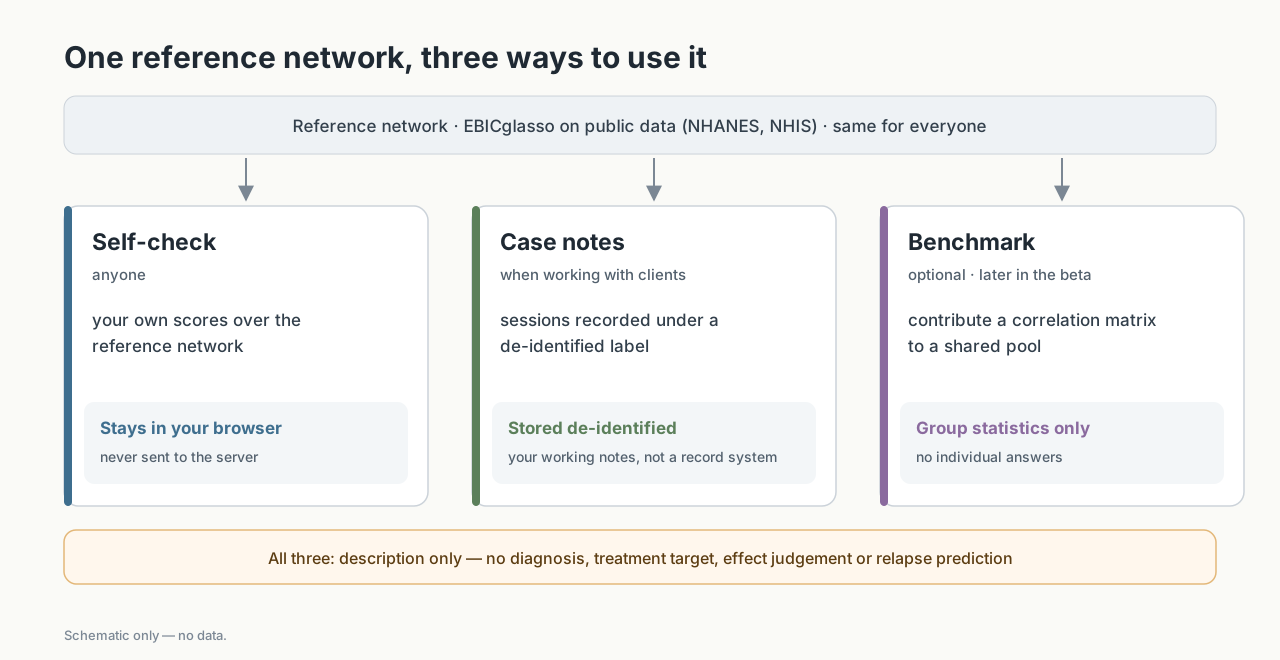
One reference network, three depths of use. Each path has its own data rule.
Two ways in: for yourself, or for a case
PsyNexa has no role field. Nobody is asked whether they are a clinician, a counsellor, a student or simply curious. The difference is in what you do.
Self-check. Anyone can enter their own scores and look at them against the reference network. The scores stay in the browser. By default they disappear when the tab closes; if you choose, they can be kept on the same device so you can look back at earlier entries. Either way, they are never sent to our server.
Case notes. Anyone who works with clients, such as a clinician or counsellor, can create a case under a de-identified label (never a name) and record scores session by session to see how they change. Case notes are that person’s own working notes, stored de-identified on our server so they survive a change of device. They are not a clinical record system, and the interface asks you not to type identifying details.
A third path is optional and comes later in the beta: benchmark contribution, where a user can choose to contribute a correlation matrix — group-level statistics only, no individual answers — to a shared pool.
Where the depth is
Thirteen weeks of posts are, in a sense, the manual for the deeper layers:
- Centrality, read carefully. Four centrality measures with their stability shown beside them, and the reminder from Week 2 that central does not mean “treat first” (Bringmann et al., 2019).
- Change across sessions. For a case, a view of how scores, laid over the same reference network, shift over time — observation of change, not a judgement about whether treatment is working.
- Language level. The same page in everyday language or in technical terms, so a clinician can switch to plain wording when explaining a figure to a client.
- AI-assisted drafts. With your own Claude API key, PsyNexa can draft a written report from the de-identified pattern. A draft is a draft: you read it, edit it, and decide what goes into a PDF.
Shortly after launch, a cross-scale reference layer will follow: PHQ-8 and GAD-7 items estimated in the same respondents from NHIS 2019, 2022 and 2025, labelled throughout as a US adult sample and shown as an overlay alongside the PHQ-9 network, not as a replacement for it. On the platform, that is the point at which the connections between the two questionnaires become measured partial correlations rather than an estimate built from two separate reference structures.
What PsyNexa does not do
The series has returned to the same boundaries again and again, and the platform is built inside them.
PsyNexa does not diagnose. It does not recommend treatment, choose a treatment target, judge whether a treatment has worked, or predict relapse. It presents reference networks and recorded scores as basic information that clinicians and counsellors can draw on for case formulation and psychoeducation — and the interpretation stays with the person reading.
Two other choices follow from the same principle. PsyNexa does not ask for your name, your profession or your licence, and it does not sell personal data. Sign-in is by OAuth or a magic link; payment, when it begins, is handled by a payment provider that holds those details directly.
How the free beta period works
From 1 February 2027, anyone in a country where our legal review is complete can sign up, and during the free beta period every account there has the features that will later be the Pro plan; AI reports during this period use your own API key. No payment details are asked for.
Paid plans begin on 1 March 2028. Prices are published on the site from day one, so nothing about them is a surprise later. Before the beta ends, account holders receive at most three service notices — the end date, the start of billing and any change to their account — and nothing else. There is no newsletter, and no marketing email.
If the beta ends and you choose not to subscribe, your existing cases and entries remain viewable; adding new sessions, longitudinal comparisons and PDF exports become part of the paid plan.
In countries where the review is not yet complete, the free plan will be available, and we are adding countries as reviews finish.
Where the series goes from here
The blog does not stop. The posts will continue, more slowly, and they will feed the book this series has been sketching: Reading Symptom Networks, an introduction to network psychometrics for clinicians, written without code.
If these thirteen weeks of posts have been useful, the simplest way to follow along is this blog’s RSS feed, or PsyNexa on X, Bluesky and Mastodon. And on 1 February 2027, if you would like to see a symptom network you can turn in your hands — your own scores laid quietly over a map drawn from thousands of other people — PsyNexa will be there.
References
- Bringmann, L. F., Elmer, T., Epskamp, S., Krause, R. W., Schoch, D., Wichers, M., Wigman, J. T. W., & Snippe, E. (2019). What do centrality measures measure in psychological networks? Journal of Abnormal Psychology, 128(8), 892–903.
- Epskamp, S., Borsboom, D., & Fried, E. I. (2018). Estimating psychological networks and their accuracy: A tutorial paper. Behavior Research Methods, 50(1), 195–212.
- Epskamp, S., & Fried, E. I. (2018). A tutorial on regularized partial correlation networks. Psychological Methods, 23(4), 617–634.
- Molenaar, P. C. M. (2004). A manifesto on psychology as idiographic science: Bringing the person back into scientific psychology, this time forever. Measurement: Interdisciplinary Research and Perspectives, 2(4), 201–218.