Series 9/13 · Book preview → Series hub
The short version. A symptom network estimated from a group is a map of the “average person,” and nothing guarantees it fits the person in front of you. That is why network psychometrics is extending toward the individual level — the idiographic approach. But an individual network describes how one person’s symptoms moved together over time; it is not a prescription for what to treat.
The trap of the average
The networks we covered in weeks 1–4 — PHQ-9 and GAD-7 symptoms as nodes, partial correlations as edges — were all estimated across people (between-person). “Among people with depression, sleep problems and fatigue are strongly connected” is a statement about a group.
The problem is that nothing guarantees this group-level structure reappears within a person. Fisher, Medaglia & Jeronimus (2018, PNAS) took this head-on: group-level statistics generalize to the individual only if the process is ergodic — the same dynamics operate in everyone, and they do not change over time — and human psychological processes usually are not. In their data, the variance around the expected value was two to four times larger within individuals than within groups.
That conclusion was not accepted wholesale. Hamaker & Ryan (2019) countered that the two variances measure different things, so the comparison itself does not hold; Adolf & Fried (2019) pointed out that ergodicity is sufficient but not necessary for group-to-individual generalization, and that design choices such as randomization can make conditional generalization possible. Yet both sides agree on one thing: if you want to apply a group map to an individual, you have to show separately that it applies.
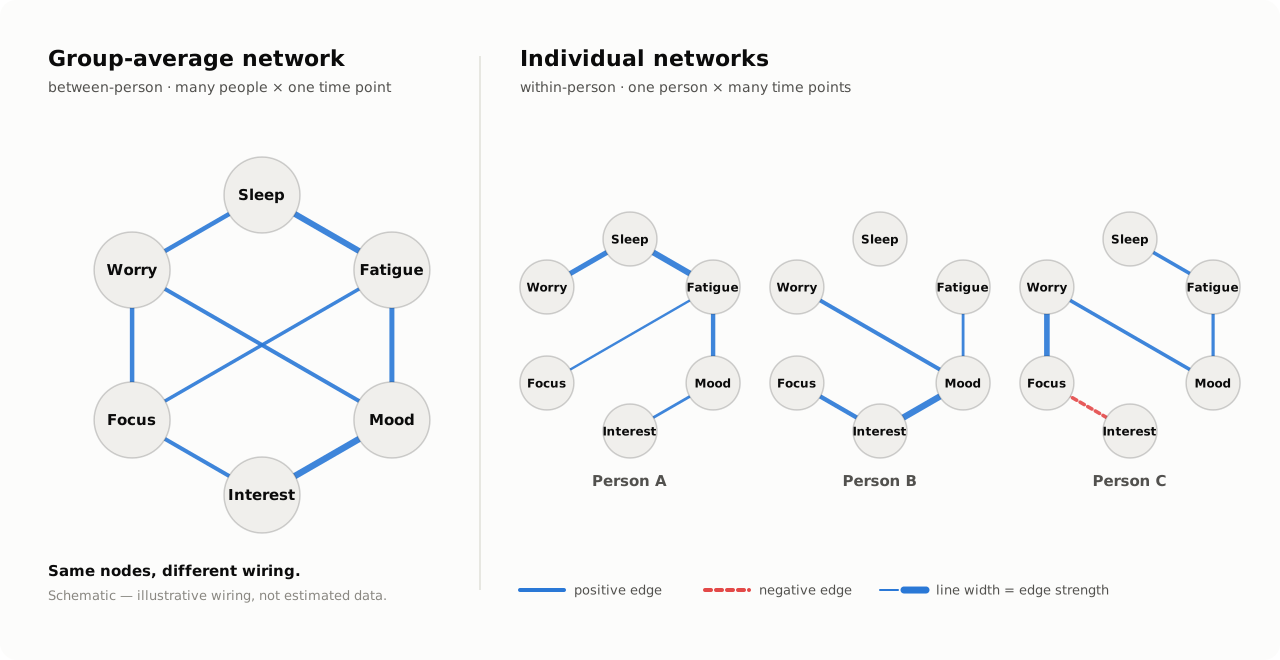
Figure. Left: one group-average network estimated across people. Right: three individual networks — same nodes, different wiring. Schematic; illustrative wiring, not estimated data.
What an idiographic network is
The idiographic approach reverses the direction. Instead of gathering many people at one time point, it measures one person repeatedly across many time points and draws a network from how that person’s symptoms rose and fell together.
- Nomothetic: many people × one time point → structure between people
- Idiographic: one person × many time points → structure within this person
The two pictures can share the same nodes and still differ in their wiring, and both are legitimate. The group map tells you where to start; the individual map shows the terrain as estimated within that person — and, being an estimate, it is not exempt from the stability problems we discussed in week 4, all the more so with few time points. The translator’s stance we held through the genealogy posts of weeks 5–8 applies here unchanged: neither lens is the correct one; they answer different questions.
Where PsyNexa stands
PsyNexa does not estimate individual time-series networks. Estimating a person’s own partial-correlation structure typically requires dozens of repeated measurements, and a handful of PHQ-9 administrations two weeks apart cannot do it, in principle. So we designed it differently: the edge structure is taken from a group reference network built on public data and held fixed, and the user’s scores from each administration are overlaid as activation levels on the nodes. As administrations accumulate, you can see how that person’s position has moved on the same map (self-check data never leave the device — Zero-Upload). This is an idiographic trajectory on a nomothetic map, not an idiographic map in its own right. Keeping that boundary sharp is the translator’s discipline. Individual time-series estimation is something we will revisit; we make no promise about it now.
On top of that, we draw firm lines:
- An individual trajectory is an aid for observing change and reflecting on it — material for self-reflection, case formulation, and supervision.
- A symptom with high centrality is not declared an “intervention target” — treat this and the rest will follow. Position in a network describes an association structure; it does not prove causation (Bringmann et al., 2019).
- An individual trajectory is not used to diagnose, to judge treatment effect, or to predict relapse. The picture says “what moved together” and stops there.
Combining several scales into a single network for one person (an integrated symptom network) is a natural next step, but its scope and composition remain a planned extension — and, again, not something we promise now.
The question that remains
When the group map and the individual map disagree, which should a clinician trust? There is no answer. But looking at one person repeatedly tells you more about that person than leaning on the average does — and that is the core of the idiographic turn.
References
- Fisher, A. J., Medaglia, J. D., & Jeronimus, B. F. (2018). Lack of group-to-individual generalizability is a threat to human subjects research. Proceedings of the National Academy of Sciences, 115(27), E6106–E6115. https://doi.org/10.1073/pnas.1711978115
- Hamaker, E. L., & Ryan, O. (2019). A squared standard error is not a measure of individual differences. Proceedings of the National Academy of Sciences. https://doi.org/10.1073/pnas.1818033116
- Adolf, J. K., & Fried, E. I. (2019). Ergodicity is sufficient but not necessary for group-to-individual generalizability. Proceedings of the National Academy of Sciences. https://doi.org/10.1073/pnas.1818675116
- Molenaar, P. C. M. (2004). A manifesto on psychology as idiographic science: Bringing the person back into scientific psychology, this time forever. Measurement: Interdisciplinary Research and Perspectives, 2(4), 201–218.
- Bringmann, L. F., Elmer, T., Epskamp, S., Krause, R. W., Schoch, D., Wichers, M., Snippe, E., & Wigman, J. T. W. (2019). What do centrality measures measure in psychological networks? Journal of Abnormal Psychology, 128(8), 892–903.
Part 9 of a 13-week series on network psychometrics.