The short version
In the autumn of 1895, Sigmund Freud — then a working neurologist, not yet the Freud of dream interpretation — drafted a manuscript that tried to build the mind entirely out of connected neurons and the flow of excitation between them. He never finished it, never published it in his lifetime, and later treated it as a dead end. The editors who found it among his letters to Wilhelm Fliess gave it the title we use today: Project for a Scientific Psychology.
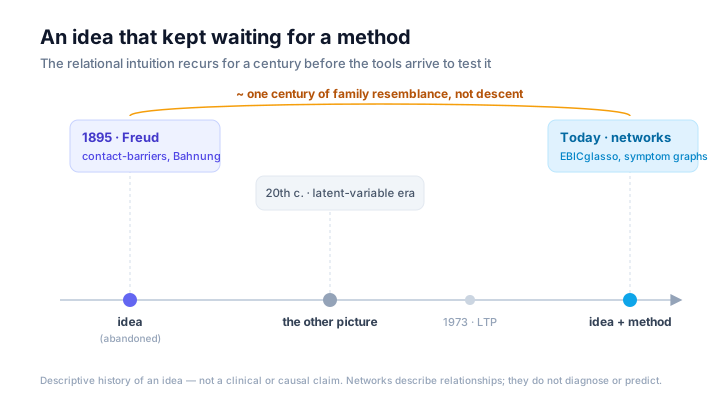
It is tempting to read that draft as a prophecy — “Freud predicted synaptic memory!” — and much of the later literature does exactly that. This post resists that reading. The Project is not a hidden blueprint for modern network psychometrics, and Freud was not secretly a network scientist. What it offers is more modest and more interesting: an early, abandoned attempt to treat mental life as a matter of relations between parts rather than a single hidden essence. That relational impulse is a distant relative of the network view — a family resemblance across a century, not a straight line of descent.
What Freud actually wrote
Freud conceived the Project in the spring of 1895 and drafted most of it that autumn, mailing notebooks to his friend Wilhelm Fliess. He called it, privately, “Psychology for Neurologists.” The ambition was to derive psychological phenomena — perception, memory, affect, even symptom formation — from the mechanics of nerve cells.
The recent recognition of the neuron as a discrete cell gave him his raw material. He proposed two systems of neurons, which he labeled φ (phi) and ψ (psi), soon joined by a third, ω (omega), concerned with perception. Between them lay what he called contact-barriers — the gaps that a later generation would name synapses. And he gave those gaps a property: Bahnung, usually rendered “facilitation,” though the German carries the sense of grooving — a path worn smoother by use. When excitation passes repeatedly across a contact-barrier, Freud argued, the barrier changes and the path becomes easier to travel again.
Memory, in this scheme, is not stored in a place. It is the pattern of facilitations between neurons — the differences in how easily excitation moves along one path versus another. Later neuroscientists noticed that this sits surprisingly close to long-term potentiation, the synaptic mechanism of learning described experimentally in 1973, nearly eight decades after Freud set the idea down. That resemblance is real, and it is why the Project keeps getting rediscovered.
Why this is not a “Freud saw it all” story
Here is where it is easy to go wrong, so it is worth stating plainly.
Freud did not anticipate network psychometrics. He was reaching for a neurobiological account of the mind — excitation moving through physical nerve cells — not a statistical model of how measured symptoms relate to one another across a population. Those are different projects with different objects. A partial-correlation network of PHQ-9 items and Freud’s φ-ψ-ω diagram share a picture — dots and lines — but not a method, a data source, or a claim.
And he abandoned it. The most honest thing about the Project is its unfinished state. Freud left the manuscript in a drawer, never published it, and moved decisively toward a psychology stated in mental rather than physical terms. He judged the attempt a failure — at one point in the text, having introduced omega neurons, he concedes he cannot explain how excitation there becomes conscious experience at all. The tools of 1895 could not carry the weight of the idea, and he knew it.
That abandonment is not an embarrassing footnote to skip past. It is the point. The relational intuition — the mind is made of parts that act on each other — kept reappearing across the history of psychology precisely because no single era had the means to make it fully work. Freud reached for it, found the machinery wanting, and let it go.
The thread worth keeping
Strip away the neurons, the untestable mechanics, and the ever-present mistranslation risk, and one thing in the Project genuinely rhymes with the network view: the instinct to ask what happens between elements rather than to posit one hidden thing beneath them.
The paradigm that eventually won out — the latent-variable model — reads a set of symptoms as surface indicators of an underlying entity: “depression” causing low mood, fatigue, and poor sleep all at once. The network view shifts the emphasis. Perhaps sleep loss drives fatigue, fatigue drives poor concentration, and the cluster we name a disorder is the pattern of connections itself. Freud’s Bahnung — pathways grooved deeper with use — lives in the same conceptual neighborhood as that second picture, even though he was talking about neurons and we are talking about measured symptoms.
We take a deliberate position on this at PsyNexa: we are translators, not integrators. The network view and the latent-variable paradigm are two ways of drawing the same clinical reality, and we do not claim one is correct and the other wrong. Reading Freud’s abandoned draft is useful not because it proves the network view was always right, but because it shows how old and how recurring the relational impulse is — and how long it waited for methods that could hold it.
What actually made the difference
What Freud lacked was not the idea but the means: a way to decide which connections between observed variables are real and which are artifacts of everything else in the system. That is precisely what modern tools like regularized partial-correlation estimation (EBICglasso) provide — the subject of an earlier post in this series. The intuition is more than a century old. The method that lets us draw a defensible network from actual data is recent.
That gap — between an intuition that keeps recurring and the methods that finally give it teeth — is the real subject of this series. Freud’s 1895 draft is one of its earliest chapters, and a cautionary one: having the right shape of an idea is not the same as being able to test it.
A note on scope: this is a piece about the history of an idea, not a clinical claim. Symptom networks — Freud’s or ours — describe patterns of relationship. They do not diagnose, predict a course, or prescribe a treatment.
Sources: Freud’s Project for a Scientific Psychology (drafted 1895; first published 1950, within the Fliess correspondence; Standard Edition, vol. 1). On the resemblance to long-term potentiation: Centonze et al. (2004), Neuroscience*. On the “contact-barrier” and Bahnung terminology and Freud’s move away from neuroscience: reviews in the neuropsychoanalysis literature.*