The Stoics built the first psychological model in which emotions were not things but relations between judgments — and in which no hidden faculty sat above those judgments explaining them. That is a structural claim, not a claim of ancestry. Chrysippus did not anticipate partial correlations, and nobody in Athens in 250 BCE was thinking about comorbidity. But if you strip network psychometrics down to its two load-bearing ideas — that psychological states are constituted by their connections, and that you do not need a latent cause behind them — you find both ideas fully formed in Stoic psychology. This post is about that resemblance, and about being honest regarding its limits.
This is the fifth post in our series, and the first that steps away from method. The earlier posts covered why comorbidity motivates the network view, what centrality measures, why EBICglasso estimates partial correlations, and how bootstrap stability decides what you may interpret. Over the next four weeks we look back instead: where the ideas came from, and what the field chose to forget.
A warning about reading history backwards
Historians have a name for the mistake this post could easily make: Whig history — narrating the past as a road that leads inevitably to the present, casting earlier thinkers as early, imperfect versions of ourselves. Network psychometrics is young, and young fields are especially tempted to recruit distinguished ancestors.
So the rule here is strict. The Stoics are read on their own terms first. Where a structural parallel to network thinking exists, it is named as a parallel — a similarity of form — not as a precursor or an origin. And where the Stoic picture differs from anything a modern psychometrician would say, that difference gets equal space.
What the Stoics actually claimed
The Stoic account of the emotions (pathē, usually translated “passions”) comes down to us mostly secondhand — through Cicero’s Tusculan Disputations, Galen’s polemics, Diogenes Laertius, and the surviving works of Seneca and Epictetus. Reconstructing it is scholarship, not reading; Long and Sedley (1987), Graver (2007), and Brennan (2005) are the standard guides. With that caveat, four claims are well attested.
1. A passion is a judgment. For Chrysippus, distress is not caused by a judgment that something bad is present; distress is that judgment, held with a particular freshness and force. Fear is the judgment that something bad is coming. Delight is the judgment that something good is present; appetite, that something good is coming. The famous line from Epictetus — that people are disturbed not by things but by the opinions they hold about things — is the popular form of a technical thesis.
2. Passions form a system. The four generic passions are not a list; they are a two-by-two grid. Cross good versus bad with present versus future and you have generated all of them. Every specific passion — grief, envy, anger, longing — is a species of one of the four, defined by adding a further judgment. Anger, in the Stoic definition, is appetite for revenge plus the judgment that one has been wronged. The passions are related to one another definitionally, through the judgments they share.
3. Passions unfold as a sequence. Seneca’s On Anger (Book 2) describes what happens in the moment. First there is an involuntary movement — a jolt, a flush, a catch in the breath — which the Stoics called a pre-passion (propatheia) and which even the sage experiences. Then comes the impression (phantasia) that something bad has happened. Then, decisively, comes assent (synkatathesis): the mind agrees with the impression. Only then is there a passion, and once assent is given the passion runs beyond the mind’s control, like a body that has stepped off a cliff.
4. There is no separate irrational part. This is the claim that most sharply divided Chrysippus from Plato before him and from Posidonius after him. Plato’s soul had three parts; reason ruled, or failed to rule, the appetitive and spirited parts beneath it. Chrysippus rejected the hierarchy. The governing faculty (hēgemonikon) is one thing, and a passion is that one faculty in a particular condition — reason gone wrong, not something other than reason. Galen spent a good deal of his treatise On the Doctrines of Hippocrates and Plato attacking exactly this point.
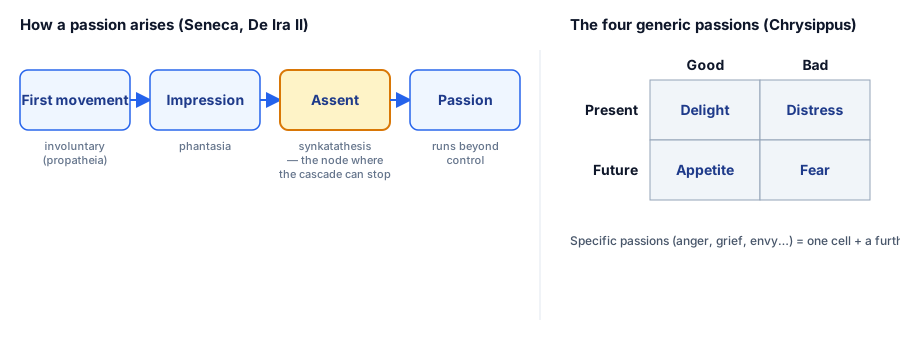
Left: the Stoic account of how a passion arises — an involuntary first movement, an impression, assent, and only then a passion. Right: the four generic passions as a grid generated by two judgments. The specific passions are species defined by adding further judgments.
Where the structural parallel holds
Set claims 2 and 4 next to the network theory of mental disorders as Borsboom (2017) states it, and the resemblance is not vague.
Relational constitution. In the network view, a disorder is not a hidden entity that produces symptoms; it is a stable pattern of symptoms sustaining one another. Depressed mood, insomnia, fatigue, and concentration difficulty are not four measurements of one underlying thing; they are four states that are connected. The Stoic passions are likewise defined by their connections to one another — anger to appetite, grief to distress, each specific passion to the generic judgment it shares. What a passion is is fixed by its place in a system of judgments.
No latent cause above the states. The latent-variable model says that a common cause explains why symptoms co-occur. Plato’s tripartite soul is, in form, a common-cause model: the passions behave as they do because of the nature of the lower parts. Chrysippus refused this. There is no lower part. The states of the one faculty explain one another; nothing sits above them. That is, formally, the move that network psychometrics makes when it declines to posit a latent variable and asks instead how symptoms relate.
Cascades. The Stoic sequence — first movement, impression, assent, passion — is a chain in which one state makes the next more likely, with a critical node (assent) at which the cascade can be stopped or not. It is a pathway description, and it is the reason the Stoics thought intervention was possible at all: you cannot help the jolt, but you can withhold assent. Readers who work with activation pathways in symptom networks will recognize the shape.
These three points are why the title of this post is not a metaphor. The Stoic model of the passions has the form of a cognitive network: relationally defined nodes, no latent cause, sequential activation.
Where it does not hold
Now the other half of the promise.
No measurement. The Stoics had no items, no scales, no samples. The “connections” between passions are conceptual — relations of definition and entailment — not statistical dependencies estimated from covariance. When a network psychometrician says two symptoms are connected, she means a partial correlation survived regularization in a sample of some thousand people. When Chrysippus says anger involves appetite, he means the concept of anger contains the concept of appetite. These are different kinds of claim, and the second cannot be tested by the first.
No comorbidity problem. Network psychometrics grew out of a specific puzzle: diagnostic categories overlap far more than a latent-variable picture predicts. The Stoics had no diagnostic categories to overlap. Their problem was ethical — how to live without being at the mercy of one’s passions — and their model was built to answer that, not to explain why depression and anxiety co-occur.
A different notion of health. The Stoic ideal was apatheia: freedom from the passions altogether, replaced by the sage’s “good feelings” (eupatheiai). No modern clinician, and no network model, treats the absence of emotion as the target state. The network view is descriptive about what sustains a disorder; the Stoic view is prescriptive about a whole way of being. Reading the latter as an early version of the former erases what the Stoics were actually for.
Monism was contested, not settled. It is tempting to present Chrysippus’s flat psychology as the enlightened view and the Platonic hierarchy as the error. But Posidonius — himself a Stoic — reintroduced irrational faculties precisely because he thought the monist account could not explain why passions persist after the judgment changes. The ancient debate did not resolve in favor of the network-shaped side. It stayed open, as the latent-variable-versus-network debate is open today.
Why it matters that the form is old
If the Stoic model is not an ancestor, why write about it in a series on network psychometrics?
Because it demonstrates that the two ideas at the base of the network approach — relational constitution and the refusal of a hidden common cause — are not artifacts of graphical LASSO or of twenty-first-century dissatisfaction with the DSM. They are old, general options in the theory of mind, argued about by people with no statistics at all, and argued about against the hierarchical alternative that later became the psychometric mainstream. The latent-variable model and the network model are not “old theory” and “new method.” They are two structural intuitions about the mind that have been in tension for a very long time.
That framing changes how the modern debate should be read. When Fried, Borsboom, and their critics argue about whether symptom networks are real or whether a common factor is doing the work, they are not simply arguing about model fit. They are continuing a disagreement about whether psychological states are explained from above or from beside. Knowing that helps.
There is also a line of actual descent worth noting, carefully. Cognitive behavioral therapy’s founders were explicit about their debt: Ellis cited Epictetus at the front of Reason and Emotion in Psychotherapy (1962), and Beck (1976) named the Stoics as the philosophical origin of the cognitive model. CBT’s cyclical formulation — thought, feeling, behavior, each feeding the next — is a direct heir. Whether that cyclical formulation and the symptom network are the same thing is the question for week eight. The Stoics are where both stories begin.
A closing caution, in the Stoics’ own spirit
Nothing above licenses the claim that Stoic practice “works” as a treatment, or that a symptom network shows where to intervene. The Stoics thought assent was the node to act on; a network model can show which symptoms are connected, but it cannot by itself tell you which connection is causal, which is modifiable, or what changing it would do. Centrality is not a treatment target — a point we made in week two and will keep making. The parallel is in the form of the models, not in any claim about what to do with them.
This post is educational reference material about the history and structure of psychological models. It does not describe diagnosis, treatment, or prognosis.
References
- Beck, A. T. (1976). Cognitive therapy and the emotional disorders. International Universities Press.
- Borsboom, D. (2017). A network theory of mental disorders. World Psychiatry, 16(1), 5–13.
- Brennan, T. (2005). The Stoic life: Emotions, duties, and fate. Oxford University Press.
- Cicero. Tusculan Disputations, Books III–IV.
- Ellis, A. (1962). Reason and emotion in psychotherapy. Lyle Stuart.
- Epictetus. Enchiridion, §5.
- Galen. On the Doctrines of Hippocrates and Plato, Books IV–V (P. De Lacy, Ed. & Trans., 1978–1984).
- Graver, M. R. (2007). Stoicism and emotion. University of Chicago Press.
- Long, A. A., & Sedley, D. N. (1987). The Hellenistic philosophers, Vol. 1, §65 “The passions.” Cambridge University Press.
- Nussbaum, M. C. (1994). The therapy of desire: Theory and practice in Hellenistic ethics. Princeton University Press.
- Seneca. De Ira (On Anger), Book II, 1–4.